 Datum Design Journal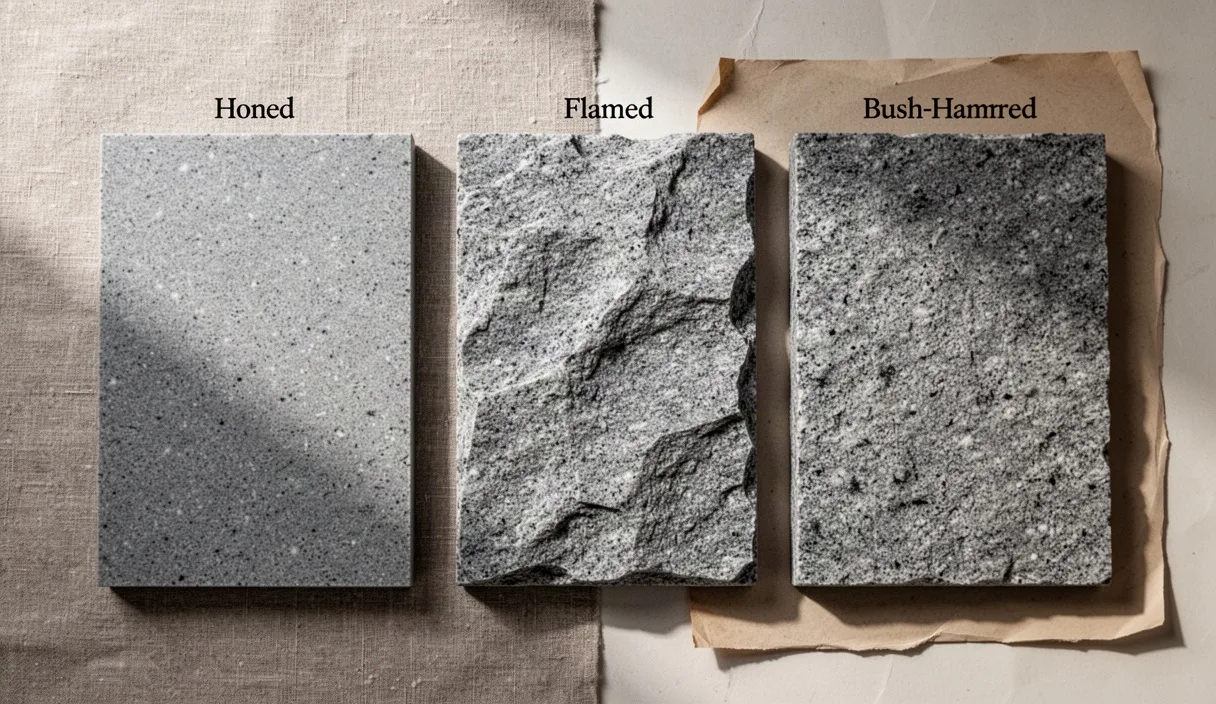
Specifying natural stone finishes requires a clear understanding of mineralogy, surface geometry, and operational wear. Dimensional stone reacts differently to mechanical abrasives, high-temperature thermal treatments, and impact tooling. A specification that simply states granite to be slip resistant or non-slip provides insufficient contractual and technical control. Specifiers must define the processing method, the resulting surface roughness profile, and the measurable friction targets under wet site conditions.
Three mechanical and thermal finishes dominate commercial stone specifications: honed, flamed, and bush-hammered. Honed finishes use progressively finer abrasive grits to create a flat, matte surface. Flamed finishes rely on thermal shock to spall the stone face, creating an undulating crystalline texture. Bush-hammered finishes employ mechanical impact to pulverize points across the face, leaving a pitted, textured matrix. Each process alters the mineral matrix to a different depth, affecting water absorption, slip resistance, and weathering durability.
Pendulum Test Values and Wet Dynamic Coefficient of Friction
Slip resistance for pedestrian stone surfaces must be evaluated under wet conditions. Dry friction values provide little indication of public safety because almost all sound mineral surfaces exhibit adequate traction when clean and dry. Two testing metrics govern specifications: Pendulum Test Value (PTV), measured in accordance with EN 16165 Annex C or BS 7976-2, and wet Dynamic Coefficient of Friction (DCOF), measured per ANSI A326.3.
The pendulum test uses a calibrated rubber slider attached to a spring-loaded foot that swings across a wetted surface. For external paving, urban plazas, and commercial entries subject to rainwater transfer, Slider 96 (formerly known as Four-S rubber) simulates pedestrian footwear. Under EN 16165, a wet PTV of 36 or higher signifies a low slip potential. Honed finishes produced with abrasive discs finer than 220 grit regularly fail to achieve this benchmark, frequently yielding wet PTV ratings between 24 and 32. To achieve a wet PTV of 36 or higher on a honed surface, the abrasive sequence must stop at 120 grit or 180 grit, depending on the mineral hardness of the stone.
Flamed and bush-hammered textures generate higher surface roughness profiles, producing wet PTV results that regularly exceed 45. Bush-hammered finishes consistently yield wet PTV ratings between 55 and 70, making them suitable for sloped walkways and stair nosings. When using ANSI A326.3 for interior transition zones exposed to wet traffic, designers should specify a minimum wet DCOF of 0.42 for level interior spaces and 0.55 for exterior approaches or ramps.
| Finish Type | Average Roughness (Ra, micrometers) | Typical Wet PTV (Slider 96) | Wet DCOF (ANSI A326.3) | Slip Potential (Wet Conditions) |
|---|---|---|---|---|
| Honed (400 grit) | 0.8 to 1.6 | 22 to 29 | 0.28 to 0.36 | High |
| Honed (120 grit) | 2.4 to 4.2 | 35 to 41 | 0.43 to 0.49 | Moderate to Low |
| Flamed (Thermal) | 8.5 to 16.0 | 44 to 56 | 0.58 to 0.68 | Low |
| Fine Bush-Hammered | 14.0 to 22.0 | 52 to 64 | 0.65 to 0.76 | Very Low |
| Coarse Bush-Hammered | 25.0 to 45.0 | 62 to 74 | 0.72 to 0.85 | Very Low |
Specifiers must note an exception: Slider 55 (TRL rubber) must be specified instead of Slider 96 when testing surfaces intended for barefoot traffic, such as pool decks, wellness areas, or locker rooms. Slider 55 is softer and represents bare human skin and rough outdoor surfaces more reliably.
Thermal Shock Effects on Igneous Stone Crystals
The flamed, or thermal, finish is produced by passing an automated high-temperature torch flame across the wet-sawn face of the stone. Fuel mixtures of oxygen and propane or oxygen and acetylene generate flame temperatures between 1300 and 1800 degrees Celsius. The torch moves across the slab at a controlled velocity, typically between 800 and 1400 millimeters per minute, immediately followed by a water-quench spray.
This process relies on differential thermal expansion among the component minerals of igneous rock. Quartz plays the primary role. At 573 degrees Celsius, alpha-quartz undergoes an instantaneous displacive phase transition into beta-quartz, accompanied by a volumetric expansion of roughly 0.8 percent to 1.3 percent. Surrounding feldspars and micas expand at lower rates and do not exhibit this phase inversion. The resulting internal shear stress fractures the quartz crystals along cleavage planes, causing mineral fragments to spall off the surface.
Petrographic composition determines whether a stone can accept a thermal finish:
- Granites and Granodiorites: Stone containing 20 percent to 38 percent quartz responds evenly to flaming, producing uniform texturing without deep pits.
- Charnockites and Syenites: Lower quartz fractions (often under 12 percent) lead to incomplete, patchy spalling that leaves sawn tool marks visible across the slab.
- Gabbros and Basalts: These mafic rocks contain negligible free quartz and primarily consist of plagioclase feldspar and pyroxene. Direct flaming can cause melting, glass formation, or uncontrolled structural shattering rather than clean spalling. Flaming should not be specified for true black granites (gabbros).
A critical engineering consideration is sub-surface damage. The thermal gradient induces micro-fissuring that extends beyond the spalled surface into the sound stone beneath. Microscopic examination routinely identifies micro-cracks extending 1.5 to 3.5 millimeters into the stone matrix. This weakened zone exhibits reduced flexural strength and increased initial water absorption, which must be accounted for when calculating paver thickness for load-bearing installations.
Bush-Hammering Depth Tolerances for Pedestrian Paving
Bush-hammering is a mechanical impact process that fractures the surface using a tool head faced with an array of pyramidal carbide points. As the pneumatic or hydraulic head impacts the stone, it crushes the mineral grains, leaving a texture of light-colored, micro-fractured indentations against the darker crystalline background.
Tooling geometry governs the resulting profile depth. Tool heads are categorized by the number of points on the face:
- Coarse (9-point to 12-point heads): Produces impact pits spaced 6 to 10 millimeters apart with surface relief depths ranging between 3.0 and 5.0 millimeters.
- Medium (16-point to 25-point heads): Produces impact pits spaced 3 to 5 millimeters apart with surface relief depths between 1.5 and 3.0 millimeters.
- Fine (36-point to 64-point heads): Produces closely spaced impact craters with surface relief depths between 0.5 and 1.5 millimeters.
For accessible pedestrian pathways compliant with accessibility standards such as the Americans with Disabilities Act Accessibility Guidelines (ADAAG) or EN 1341, coarse bush-hammered finishes present functional problems. Surface relief exceeding 3.0 millimeters causes significant rolling resistance for wheelchairs, luggage, and strollers, while increasing tripping occurrences for pedestrians using walking aids. Fine to medium bush-hammering, with a specified relief tolerance of 1.0 to 2.0 millimeters, maintains slip resistance while providing a sufficiently level walking plane.
Edge spalling represents another common physical issue with bush-hammering. When the impact tool approaches the edge of an unsupported paver, the lateral force breaks away the corner or chamfer, creating irregular joint widths. Specifications must require perimeter drafted margins. In this detail, a border 20 to 50 millimeters wide around the perimeter of the paver face is masked or left as a sawn or honed finish, with bush-hammering confined to the interior field.
Sealer Penetration Variations Across Surface Roughness Profiles
Applying penetrating impregnators (silanes, siloxanes, or fluoropolymers) protects natural stone from stains, efflorescence, and salt scaling. Impregnating sealers do not form a topical coating; they line the mineral capillaries with an oleophobic or hydrophobic layer. The penetration depth of these treatments varies widely depending on the chosen surface finish.
Honed surfaces maintain closed, tight capillary networks. Fluid movement is governed strictly by the intrinsic intergranular porosity of the stone. A 220-grit honed granite accepts penetrating sealers at an average coverage rate of 14 to 18 square meters per liter, achieving a penetration depth between 0.8 and 1.6 millimeters. The low surface area limits the speed of solvent evaporation, allowing extended dwell time during application.
Flamed surfaces introduce two factors that alter fluid dynamics: increased exposed surface area and widespread thermal micro-fissuring. Capillary suction in a flamed granite is markedly higher than in a honed sample of the same quarry block. Coverage rates drop to 5 to 8 square meters per liter because the fissures absorb greater fluid volume. Penetration depths often reach 3.0 to 5.5 millimeters. However, because the flame process destroys surface mineral density, the open capillaries permit faster fluid transit in both directions. If the sealer is applied unevenly, efflorescence salts can migrate back through these micro-fissures to deposit at the surface.
Bush-hammered surfaces present a fractured zone of pulverized stone dust that must be thoroughly removed by high-pressure washing before chemical application. If unwashed, the micro-pulverized dust absorbs the sealer, curing into a milky residue without penetrating the solid stone below. Once cleaned, a fine bush-hammered surface achieves penetration depths of 2.0 to 4.0 millimeters at coverage rates of 6 to 9 square meters per liter.
Application Protocol by Surface Type
- Substrate Moisture Verification: Confirm that the stone substrate contains less than 4.2 percent moisture content using an impedance meter, or that relative humidity is below 72 percent. Moisture trapped in micro-fissures will block the penetration of solvent-based sealers.
- First Saturation Coat: Apply the impregnator using a low-pressure chemical sprayer until the surface stays wet for 12 to 15 minutes. For flamed and bush-hammered stone, the volume must be monitored closely to ensure rapid draw does not leave dry spots.
- Second Wet-on-Wet Coat: Apply a second coat within 20 to 30 minutes of the first, before the carrier solvent fully evaporates. This is required for flamed finishes due to their elevated capillary draw.
- Excess Removal: Wipe all unabsorbed chemical from honed surfaces within 20 minutes to prevent surface hazing. Flamed and bush-hammered surfaces generally absorb the carrier completely, but puddling in low micro-relief points must be broomed out.
Exterior Freeze-Thaw Resistance Verification
Exterior horizontal paving in cold climates undergoes cyclic freezing, where trapped pore water expands by roughly 9 percent during phase transition. The resistance of a stone assembly to this action depends directly on the surface finish. Flamed and bush-hammered finishes alter the immediate outer layer of the stone, increasing the volume of water held at the zone of maximum frost exposure.
Specifiers must mandate freeze-thaw laboratory testing in accordance with ASTM C666 (Rapid Freezing and Thawing) or EN 12371 (Determination of Frost Resistance). Testing must be conducted on specimens prepared with the exact specified finish, rather than on smooth test coupons. Thermal micro-cracking lowers the frost threshold of the stone; water entering micro-fissures in flamed granite can initiate superficial spalling after 30 to 50 cycles, even when the parent rock passes 100 cycles in a honed state.
EN 12371 requires specimens to undergo 56 freeze-thaw cycles between minus 8 degrees and positive 35 degrees Celsius. Following the cycles, two criteria determine compliance:
- Flexural Strength Retention: The mean flexural strength under concentrated load (measured via EN 12372) after 56 cycles must not decrease by more than 18 percent compared to unfrozen control samples.
- Apparent Mass Loss: Total material loss from spalling, flaking, or crumbling must not exceed 1.0 percent of the initial dry mass.
Drainage design is inseparable from finish durability. Honed surfaces sheet water rapidly at a 1.5 percent gradient. Flamed and bush-hammered surfaces, due to micro-roughness and impact pits, retain water droplets across their profile unless the installation incorporates a continuous slope of at least 2.0 percent to 2.5 percent. Paving stones installed flat or with ponding depressions will experience accelerated frost decay on flamed and bush-hammered faces, leading to disaggregation of surface crystals within three to five winter seasons.
Common Mistakes
- Specifying high-grit honed finishes on exterior walkways: Calling for a 400-grit or 800-grit hone outdoors produces a surface that becomes dangerously slippery when wet, regularly dropping below a PTV of 30.
- Permitting thermal finishes on low-quartz stones: Attempting to flame basic igneous stones like gabbros, diorites, or basalts results in uneven thermal melting, surface discoloration, or deep structural cracking.
- Omitting drafted margins on coarse bush-hammered pavers: Tooling bush-hammered textures directly to the edges of pavers shears off perimeter corners, resulting in jagged, irregular joint lines and premature edge breakdown under vehicular over-ride.
- Assuming dry friction ratings apply to outdoor environments: Reviewing only static coefficient of friction or dry DCOF test reports creates a false sense of compliance for surfaces that will be exposed to rainfall or snow tracking.
- Failing to account for mechanical surface loss in thickness calculations: Flaming and coarse bush-hammering remove 2.0 to 4.5 millimeters of parent material from the sawn slab. If a project requires a 50-millimeter nominal paver, the specification must state that dimensions apply after surface texturing.
Recommended Next Steps for Project Specifications
To produce an enforceable specification for dimensional stone finishes, take the following actions during design development:
- Commission a Petrographic Examination: Obtain an ASTM C295 or EN 12407 petrographic report on the target quarry source. Verify that quartz contents exceed 20 percent if a flamed finish is intended. Check carbonate and clay contents if considering bush-hammered or honed treatments.
- Establish PTV Performance Targets in MasterFormat Section 04 40 00: State the minimum wet PTV (for example, wet PTV 45 or greater for outdoor urban paving) tested per EN 16165 Annex C using Slider 96. Do not accept generic non-slip assertions.
- Require Finished Mock-Up Testing: Direct the stone supplier to provide three production-run mock-ups measuring at least 300 by 300 millimeters, manufactured to the project-specified finish. Subject these samples to independent laboratory friction testing and surface roughness (Ra) measurement prior to quarry extraction at volume.
- Coordinate Structural Drainage Slopes: Confirm with the civil and landscape engineering teams that finished grades provide a minimum 2.0 percent slope across all flamed and bush-hammered stone planes to prevent water accumulation.
- Consult a Materials Professional: If stones are being placed in critical environments, such as freeze-thaw zones with deicing salt exposure or wet commercial interiors with heavy public throughput, engage a certified stone specialist or structural materials engineer to confirm finish suitability.